
Note
Go to the end to download the full example code.
Ex. Single ERT File Inversion (No Time-Lapse)#
This example shows a minimal, robust workflow for one ERT survey:
Accept either a folder path or a single ERT file path.
Use
ert_data_agentfunctions to load/QC/export data.Run one ERT inversion with
ERTInversion.Save inversion artifacts (model, convergence, summary) to one folder.
import json
import os
import sys
from pathlib import Path
from typing import Dict, Optional

import matplotlib.pyplot as plt
import numpy as np
import pygimli as pg

# Setup package path for development
try:
    # For regular Python scripts
    current_dir = os.path.dirname(os.path.abspath(__file__))
except NameError:
    # For Jupyter notebooks
    current_dir = os.getcwd()

# Add the parent directory to Python path
parent_dir = os.path.dirname(current_dir)
if parent_dir not in sys.path:
    sys.path.append(parent_dir)

from PyHydroGeophysX.data_processing.ert_data_agent import (
    LocalRef,
    export_for_inversion,
    load_ert_resipy,
    qc_and_visualize,
)
from PyHydroGeophysX.inversion.ert_inversion import ERTInversion

SUPPORTED_ERT_EXTENSIONS = (
    ".ohm",
    ".data",
    ".dat",
    ".stg",
    ".ares",
    ".pro",
    ".inv",
    ".txt",
    ".csv",
)

_EXTENSION_TO_INSTRUMENT = {
    ".ohm": "E4D",
    ".data": "DAS-1",
    ".stg": "Sting",
    ".ares": "ARES",
    ".pro": "Protocol DC",
    ".inv": "ResInv",
}
Resolve the Input Dataset#
def _resolve_path(path: str | Path) -> Path:
    resolved = Path(path).expanduser()
    if not resolved.is_absolute():
        resolved = (Path.cwd() / resolved).resolve()
    return resolved
def _find_ert_data_file(input_path: str | Path) -> Path:
    resolved = _resolve_path(input_path)
    if resolved.is_file():
        return resolved
    if not resolved.exists():
        raise FileNotFoundError(f"Input path does not exist: {resolved}")

    ignored_dirs = {"invdir", "results", "res", "__pycache__", ".git"}
    ignored_name_tokens = ("acknow", "readme", "license")
    ext_priority = {ext.lower(): i for i, ext in enumerate(SUPPORTED_ERT_EXTENSIONS)}

    candidates = []
    for candidate in sorted(resolved.rglob("*")):
        if not candidate.is_file():
            continue
        if candidate.suffix.lower() not in ext_priority:
            continue
        if any(token in candidate.name.lower() for token in ignored_name_tokens):
            continue
        if any(part.lower() in ignored_dirs for part in candidate.parts):
            continue
        candidates.append(candidate)

    if not candidates:
        raise FileNotFoundError(f"No supported ERT files found in: {resolved}")

    candidates = sorted(
        candidates,
        key=lambda p: (ext_priority.get(p.suffix.lower(), 999), str(p)),
    )
    if len(candidates) > 1:
        print(f"Multiple ERT files found. Using: {candidates[0]}")
    return candidates[0]
def _detect_instrument(data_file: Path) -> str:
    suffix = data_file.suffix.lower()
    if suffix in _EXTENSION_TO_INSTRUMENT:
        return _EXTENSION_TO_INSTRUMENT[suffix]
    if suffix in (".txt", ".csv"):
        return "Syscal"
    if suffix == ".dat":
        return "BERT"
    return "BERT"
Define a Reusable Data-Processing Helper#
def _process_with_data_agent(
    input_path: str | Path,
    instrument: Optional[str],
    outdir: Path,
    project_dir: Optional[str | Path],
    crs: str,
    use_source_error: bool = False,
    use_electrode_file: bool = False,
    electrode_file: Optional[str | Path] = None,
) -> Dict[str, object]:
    data_file = _find_ert_data_file(input_path)
    resolved_instrument = instrument or _detect_instrument(data_file)
    project_dir_path = _resolve_path(project_dir) if project_dir else data_file.parent
    electrode_file_path = None
    if use_electrode_file:
        if electrode_file is None:
            raise ValueError(
                "use_electrode_file=True but no electrode_file path was provided."
            )
        electrode_file_path = _resolve_path(electrode_file)
        if not electrode_file_path.exists():
            raise FileNotFoundError(f"Electrode file not found: {electrode_file_path}")
        print(f"Using electrode file: {electrode_file_path}")

    ert = load_ert_resipy(
        project_dir=str(project_dir_path),
        data_file=str(data_file),
        instrument=resolved_instrument,
        electrode_file=str(electrode_file_path) if electrode_file_path else None,
        crs=crs,
        local_ref=LocalRef(origin_x=0.0, origin_y=0.0, azimuth_deg=90.0),
    )
    artifacts = qc_and_visualize(ert, outdir=str(outdir))
    bert_path = export_for_inversion(
        ert,
        outdir=str(outdir),
        fmt="pgimli",
        use_source_error=use_source_error,
    )

    return {
        "ert": ert,
        "data_file": str(data_file),
        "instrument": resolved_instrument,
        "project_dir": str(project_dir_path),
        "use_electrode_file": bool(use_electrode_file),
        "electrode_file": str(electrode_file_path) if electrode_file_path else None,
        "artifacts": artifacts,
        "bert_path": bert_path,
    }
Configure the Single-Survey Inversion#
Edit these values directly when using the downloaded Python script or notebook with another survey.
input_path = Path(current_dir) / "data" / "ERT" / "E4D" / "2021-10-08_1400.ohm"
instrument = "E4D"
output_dir_path = Path(current_dir) / "results" / "ert_single_inversion"
project_dir = None
crs = "local"
lambda_val = 10.0
max_iterations = 10
method = "cgls"
use_gpu = False
use_source_error = False
use_electrode_file = False
electrode_file = None

output_dir_path.mkdir(parents=True, exist_ok=True)
Load, Quality-Control, and Export the ERT Data#
process_result = _process_with_data_agent(
    input_path=input_path,
    instrument=instrument,
    outdir=output_dir_path,
    project_dir=project_dir,
    crs=crs,
    use_source_error=use_source_error,
    use_electrode_file=use_electrode_file,
    electrode_file=electrode_file,
)

bert_path = process_result["bert_path"]
print(f"Input file: {process_result['data_file']}")
print(f"Instrument: {process_result['instrument']}")
print(f"BERT file: {bert_path}")
Run the ERT Inversion#
inversion = ERTInversion(
    data_file=str(bert_path),
    lambda_val=lambda_val,
    method=method,
    max_iterations=max_iterations,
    lambda_rate=1.0,
    use_gpu=use_gpu,
)
inversion_result = inversion.run()
Save Numerical Results#
result_prefix = output_dir_path / "single_ert_inversion"
inversion_result.save(str(result_prefix))

final_model_path = output_dir_path / "final_model.npy"
predicted_data_path = output_dir_path / "predicted_data.npy"
coverage_path = output_dir_path / "coverage.npy"
np.save(final_model_path, inversion_result.final_model)
np.save(predicted_data_path, inversion_result.predicted_data)
np.save(coverage_path, inversion_result.coverage)
Plot the Inverted Resistivity Model#
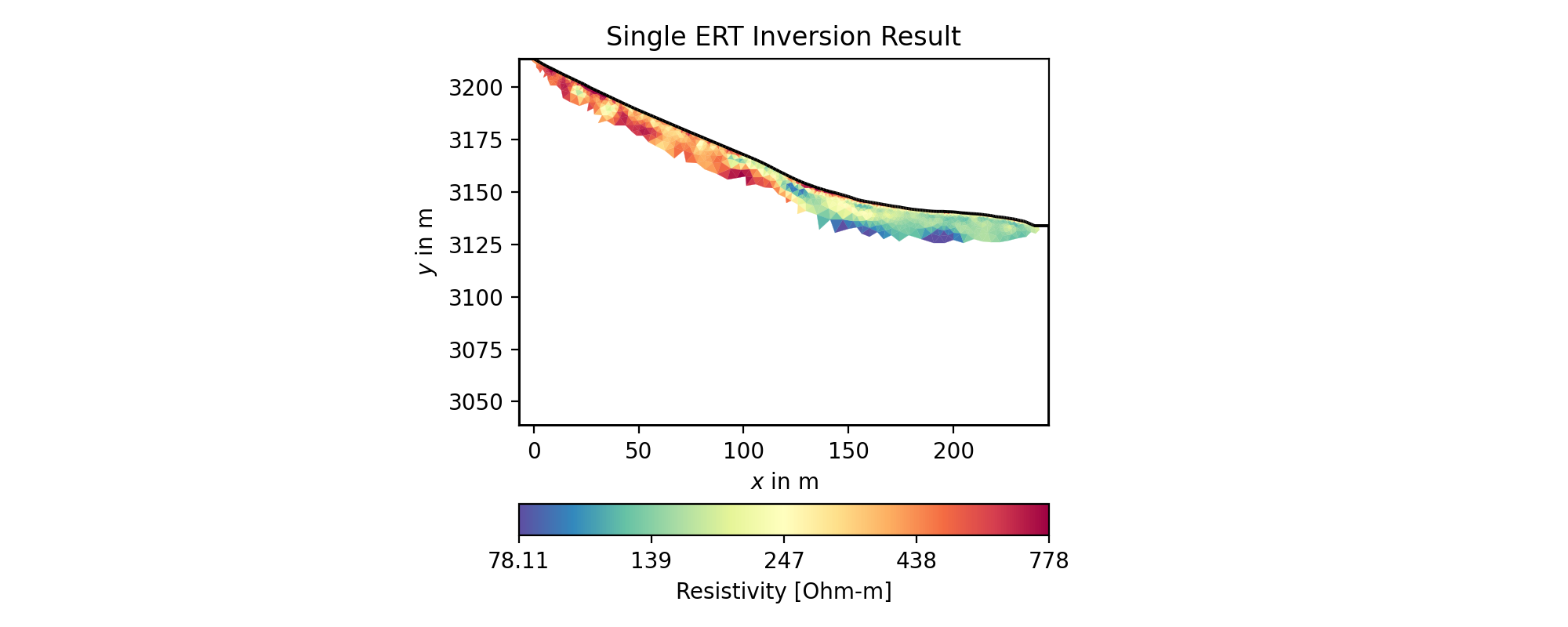
model_plot_path = output_dir_path / "single_ert_model.png"
fig, ax = plt.subplots(figsize=(10, 4))
coverage_mask = None
if inversion_result.coverage is not None:
    coverage_mask = np.asarray(inversion_result.coverage) > -1.0
pg.show(
    inversion_result.mesh,
    inversion_result.final_model,
    ax=ax,
    cMap="Spectral_r",
    cMin=float(np.percentile(inversion_result.final_model, 2)),
    cMax=float(np.percentile(inversion_result.final_model, 98)),
    logScale=True,
    label="Resistivity [Ohm-m]",
    coverage=coverage_mask,
    show=False,
)
ax.set_title("Single ERT Inversion Result")
fig.tight_layout()
fig.savefig(model_plot_path, dpi=200)
plt.show()
The inverted section shows the recovered resistivity distribution for the selected field survey.
Plot Inversion Convergence#
chi2_plot_path = output_dir_path / "single_ert_convergence.png"
if inversion_result.iteration_chi2:
    fig, ax = plt.subplots(figsize=(6, 4))
    ax.plot(inversion_result.iteration_chi2, "o-", color="black")
    ax.set_xlabel("Iteration")
    ax.set_ylabel("Chi2")
    ax.set_yscale("log")
    ax.set_title("Inversion Convergence")
    ax.grid(True, linestyle=":")
    fig.tight_layout()
    fig.savefig(chi2_plot_path, dpi=200)
    plt.show()
else:
    chi2_plot_path = None
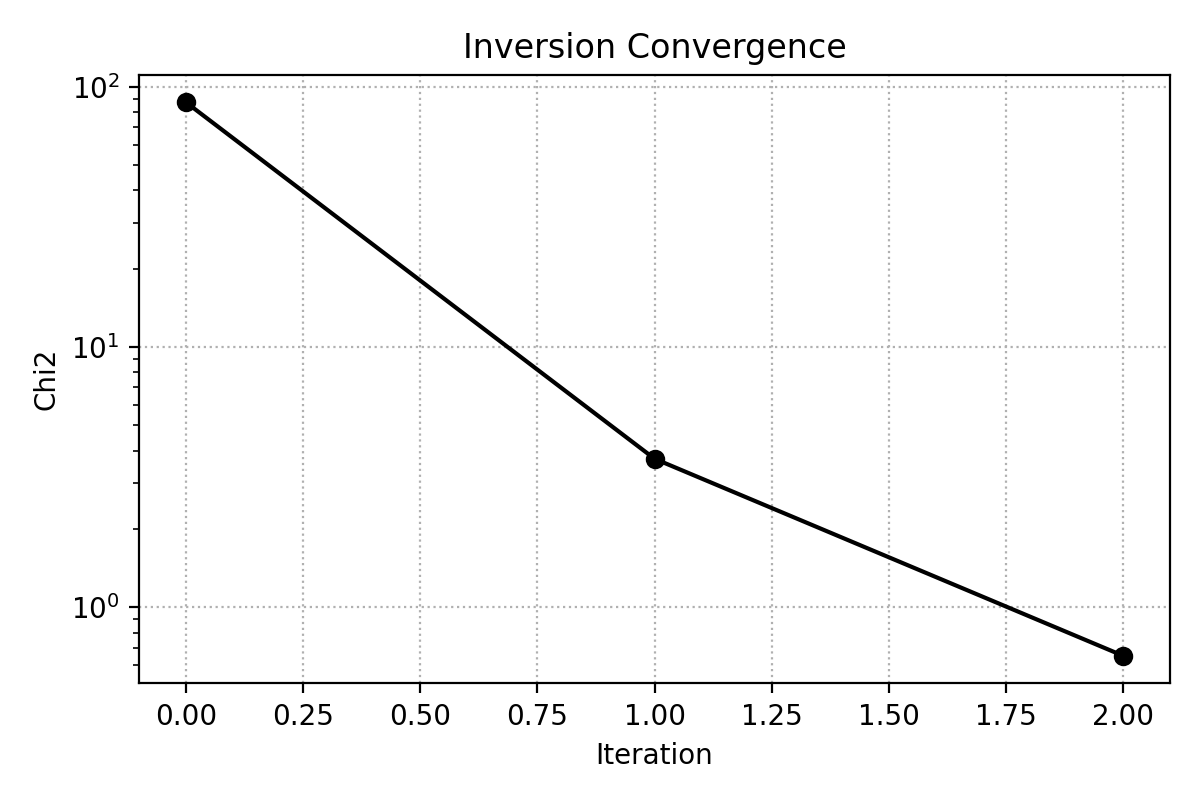
The chi-squared history documents convergence and provides a direct check on whether additional iterations materially improve the data fit.
Write a Reproducible Run Summary#
mesh_path = str(result_prefix) + ".bms"
if not Path(mesh_path).exists():
    mesh_path = None

summary = {
    "input_path": str(input_path),
    "resolved_data_file": process_result["data_file"],
    "instrument_used": process_result["instrument"],
    "use_source_error": bool(use_source_error),
    "use_electrode_file": bool(use_electrode_file),
    "electrode_file": process_result.get("electrode_file"),
    "bert_file": str(bert_path),
    "qc_artifacts": process_result["artifacts"],
    "result_pickle": str(result_prefix) + ".pkl",
    "result_mesh": mesh_path,
    "final_model_npy": str(final_model_path),
    "predicted_data_npy": str(predicted_data_path),
    "coverage_npy": str(coverage_path),
    "model_plot": str(model_plot_path),
    "convergence_plot": str(chi2_plot_path) if chi2_plot_path else None,
    "final_chi2": (
        float(inversion_result.iteration_chi2[-1])
        if inversion_result.iteration_chi2
        else None
    ),
}

summary_path = output_dir_path / "single_ert_summary.json"
with open(summary_path, "w", encoding="utf-8") as summary_file:
    json.dump(summary, summary_file, indent=2)

print("Single-file inversion finished.")
print(f"Summary: {summary_path}")
print(f"Model plot: {model_plot_path}")