
Note
Go to the end to download the full example code.
Joint ERT-SRT Inversion: Cross-Gradient and Geostatistical Coupling#
This example compares direct cross-gradient and geostatistical cross-gradient coupling using the same ERT and SRT field data. Data loading, shared settings, the two inversion runs, result saving, and visualization are presented as separate steps.
sphinx_gallery_thumbnail_path = ‘auto_examples/images/Ex_joint_inversion_fig_01.png’
import os
import sys
import numpy as np
import matplotlib.pyplot as plt
import pygimli as pg
import pygimli.physics.traveltime as tt
from pygimli.physics import ert

# Setup package path for development
try:
    current_dir = os.path.dirname(os.path.abspath(__file__))
except NameError:
    current_dir = os.getcwd()
    if (
        not os.path.exists(os.path.join(current_dir, "data"))
        and os.path.exists(os.path.join(current_dir, "examples", "data"))
    ):
        current_dir = os.path.join(current_dir, "examples")

parent_dir = os.path.dirname(current_dir)
if parent_dir not in sys.path:
    sys.path.append(parent_dir)

from PyHydroGeophysX.inversion import JointERTSRTInversion
Load the ERT and SRT field data#
print("Step 1: Load the field datasets.")

output_dir = os.path.join(current_dir, "results", "joint_inversion_compare")
os.makedirs(output_dir, exist_ok=True)

ert_file = os.path.join(current_dir, "data", "ERT", "Bert", "fielddataline2.dat")
srt_file = os.path.join(current_dir, "data", "Seismic", "srtfieldline2.dat")

if not os.path.exists(ert_file):
    raise FileNotFoundError(f"ERT file not found: {ert_file}")
if not os.path.exists(srt_file):
    raise FileNotFoundError(f"SRT file not found: {srt_file}")

ert_data = ert.load(ert_file)
srt_data = tt.load(srt_file)

print(f"ERT: {ert_data.sensorCount()} sensors, {ert_data.size()} measurements")
print(f"SRT: {srt_data.sensorCount()} sensors, {srt_data.size()} travel times")
Run the direct cross-gradient inversion#
This case uses the model smoothness matrices to construct the cross-gradient coupling.
print("Step 3: Run the direct cross-gradient inversion.")

cross_params = {
    **common_params,
    "regularization_mode": "smoothness",
    "lambda_ert": 10.0,
    "lambda_srt": 10.0,
    "lambda_cg_ert": 80.0,
    "lambda_cg_srt": 80.0,
    "cross_gradient_mode": "direct",
    "cross_gradient_source": "smoothness",
    "cross_gradient_threshold": 0.01,
}

cross_inv = JointERTSRTInversion(
    ert_data=ert_file,
    srt_data=srt_file,
    **cross_params,
)
cross_result = cross_inv.run()

cross = {
    "result": cross_result,
    "params": cross_params,
    "ert_model": np.asarray(cross_result.ert_resistivity, dtype=float).ravel(),
    "srt_model": np.asarray(cross_result.srt_velocity, dtype=float).ravel(),
    "chi2_ert_hist": np.asarray(
        [iteration["chi2_ert"] for iteration in cross_result.iteration_history],
        dtype=float,
    ),
    "chi2_srt_hist": np.asarray(
        [iteration["chi2_srt"] for iteration in cross_result.iteration_history],
        dtype=float,
    ),
}

print(f"Final ERT chi2: {cross_result.chi2_ert:.4f}")
print(f"Final SRT chi2: {cross_result.chi2_srt:.4f}")
Run the geostatistical joint inversion#
This case uses continuous spatial covariance weights for the cross-gradient neighborhood.
print("Step 4: Run the geostatistical joint inversion.")

geo_params = {
    **common_params,
    "regularization_mode": "smoothness",
    "lambda_ert": 10.0,
    "lambda_srt": 10.0,
    "lambda_cg_ert": 5000.0,
    "lambda_cg_srt": 5000.0,
    "cross_gradient_mode": "spatial",
    "cross_gradient_source": "geostat",
    "cross_gradient_corr_lengths": (4.0, 4.0),
    "cross_gradient_threshold": 0.01,
}

geo_inv = JointERTSRTInversion(
    ert_data=ert_file,
    srt_data=srt_file,
    **geo_params,
)

try:
    geo_result = geo_inv.run()
except RuntimeError as exc:
    if "GeostatisticConstraintsMatrix" in str(exc):
        raise RuntimeError(
            "Geostatistical constraints require a PyGIMLi build with "
            "GeostatisticConstraintsMatrix support."
        ) from exc
    raise

geo = {
    "result": geo_result,
    "params": geo_params,
    "ert_model": np.asarray(geo_result.ert_resistivity, dtype=float).ravel(),
    "srt_model": np.asarray(geo_result.srt_velocity, dtype=float).ravel(),
    "chi2_ert_hist": np.asarray(
        [iteration["chi2_ert"] for iteration in geo_result.iteration_history],
        dtype=float,
    ),
    "chi2_srt_hist": np.asarray(
        [iteration["chi2_srt"] for iteration in geo_result.iteration_history],
        dtype=float,
    ),
}

print(f"Final ERT chi2: {geo_result.chi2_ert:.4f}")
print(f"Final SRT chi2: {geo_result.chi2_srt:.4f}")
Save the inversion results#
Each case gets its own folder containing the recovered models, chi-square histories, and a text summary.
print("Step 5: Save the inversion results.")

run_outputs = {
    "cross_gradient_joint": cross,
    "geostat_joint": geo,
}

for case_name, output in run_outputs.items():
    case_dir = os.path.join(output_dir, case_name)
    os.makedirs(case_dir, exist_ok=True)

    np.save(
        os.path.join(case_dir, "joint_ert_resistivity.npy"),
        output["ert_model"],
    )
    np.save(
        os.path.join(case_dir, "joint_srt_velocity.npy"),
        output["srt_model"],
    )
    np.save(
        os.path.join(case_dir, "joint_ert_chi2_history.npy"),
        output["chi2_ert_hist"],
    )
    np.save(
        os.path.join(case_dir, "joint_srt_chi2_history.npy"),
        output["chi2_srt_hist"],
    )

    summary_file = os.path.join(case_dir, "summary.txt")
    with open(summary_file, "w", encoding="utf-8") as summary:
        summary.write(f"Case: {case_name}\n")
        summary.write(f"ERT file: {ert_file}\n")
        summary.write(f"SRT file: {srt_file}\n")
        summary.write(
            f"Iterations: {len(output['result'].iteration_history)}\n"
        )
        summary.write(f"Final ERT chi2: {output['result'].chi2_ert:.6f}\n")
        summary.write(f"Final SRT chi2: {output['result'].chi2_srt:.6f}\n")
        summary.write("Parameters:\n")
        for key in sorted(output["params"]):
            summary.write(f"  {key}: {output['params'][key]}\n")

    print(f"Saved {case_name}: {case_dir}")
Compare the recovered ERT and SRT models#
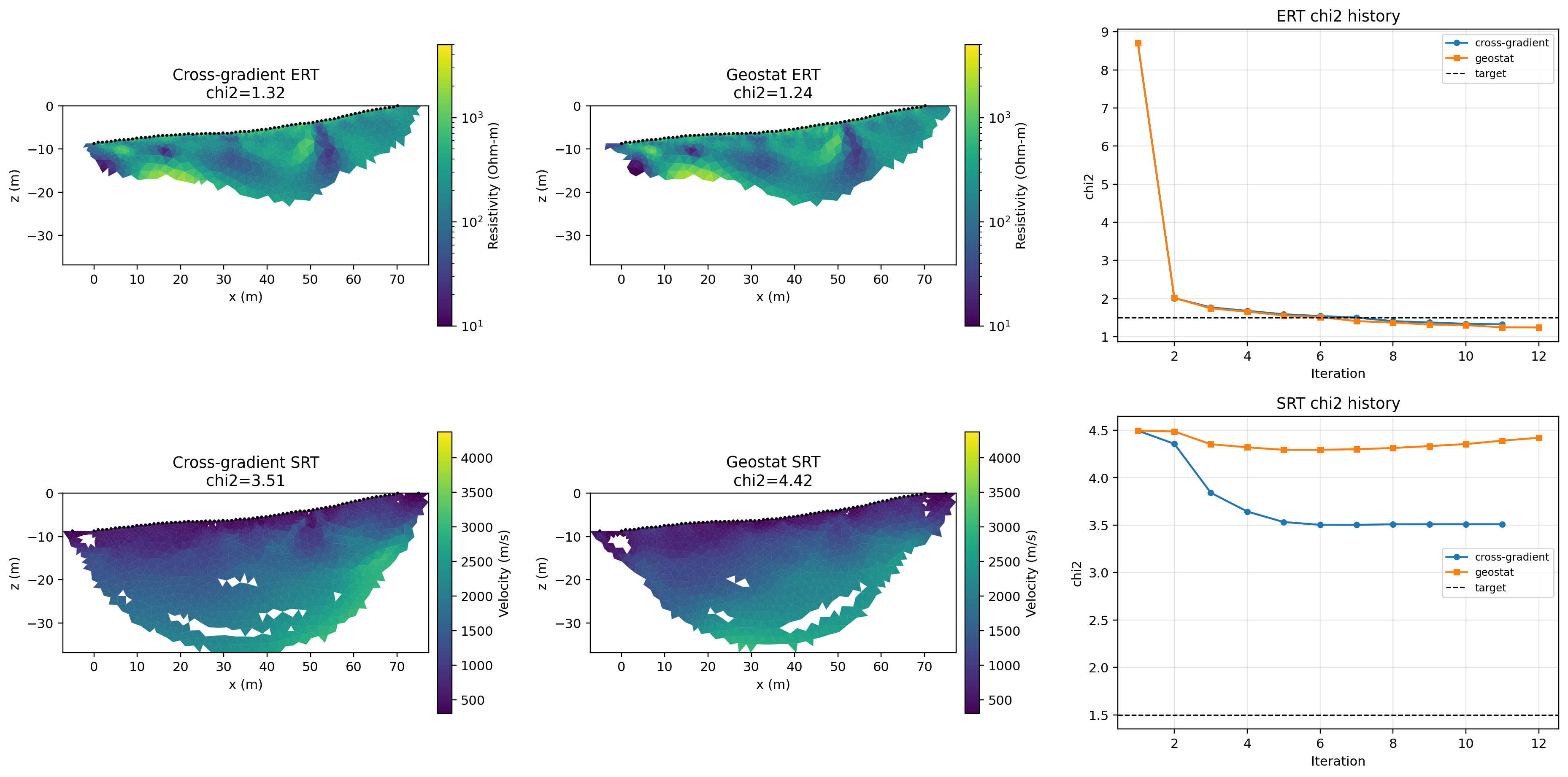
The same color limits are used across the two coupling strategies. Coverage is applied as transparency to de-emphasize poorly constrained cells.
from palettable.lightbartlein.diverging import BlueDarkRed18_18

ert_cmap = "Spectral_r"
srt_cmap = BlueDarkRed18_18.mpl_colormap

ert_vmin = float(min(cross["ert_model"].min(), geo["ert_model"].min()))
ert_vmax = float(max(cross["ert_model"].max(), geo["ert_model"].max()))
srt_vmin = float(min(cross["srt_model"].min(), geo["srt_model"].min()))
srt_vmax = float(max(cross["srt_model"].max(), geo["srt_model"].max()))

cross_ert_cov = (
    None
    if cross_result.ert_coverage is None
    else cross_result.ert_coverage > -1
)
geo_ert_cov = (
    None
    if geo_result.ert_coverage is None
    else geo_result.ert_coverage > -1
)
cross_srt_cov = cross_result.srt_coverage
geo_srt_cov = geo_result.srt_coverage
fig, axes = plt.subplots(2, 3, figsize=(17, 8.5))

ert_panels = [
    (
        axes[0, 0],
        cross_result,
        cross["ert_model"],
        cross_ert_cov,
        f"Cross-gradient ERT\nchi2={cross_result.chi2_ert:.2f}",
    ),
    (
        axes[0, 1],
        geo_result,
        geo["ert_model"],
        geo_ert_cov,
        f"Geostat ERT\nchi2={geo_result.chi2_ert:.2f}",
    ),
]

for ax, result, model, coverage, title in ert_panels:
    image = pg.viewer.mpl.drawModel(
        ax,
        result.mesh,
        model,
        cMap=ert_cmap,
        cMin=ert_vmin,
        cMax=ert_vmax,
        logScale=True,
    )
    if coverage is not None:
        pg.viewer.mpl.addCoverageAlpha(image, coverage)

    colorbar = plt.colorbar(
        image,
        ax=ax,
        orientation="vertical",
        shrink=0.9,
        pad=0.02,
    )
    colorbar.set_label("Resistivity (Ohm-m)")
    pg.viewer.mpl.drawSensors(
        ax,
        ert_data.sensors(),
        diam=0.4,
        facecolor="k",
        edgecolor="k",
    )
    ax.set_title(title)
    ax.set_xlabel("x (m)")
    ax.set_ylabel("z (m)")

axes[0, 2].plot(
    np.arange(1, len(cross["chi2_ert_hist"]) + 1),
    cross["chi2_ert_hist"],
    "o-",
    linewidth=1.5,
    markersize=4,
    label="cross-gradient",
)
axes[0, 2].plot(
    np.arange(1, len(geo["chi2_ert_hist"]) + 1),
    geo["chi2_ert_hist"],
    "s-",
    linewidth=1.5,
    markersize=4,
    label="geostat",
)
axes[0, 2].axhline(
    common_params["target_chi2"],
    color="k",
    linestyle="--",
    linewidth=1,
    label="target",
)
axes[0, 2].set_title("ERT chi2 history")
axes[0, 2].set_xlabel("Iteration")
axes[0, 2].set_ylabel("chi2")
axes[0, 2].grid(alpha=0.3)
axes[0, 2].legend(loc="best", fontsize=8)
srt_panels = [
    (
        axes[1, 0],
        cross_result,
        cross["srt_model"],
        cross_srt_cov,
        f"Cross-gradient SRT\nchi2={cross_result.chi2_srt:.2f}",
    ),
    (
        axes[1, 1],
        geo_result,
        geo["srt_model"],
        geo_srt_cov,
        f"Geostat SRT\nchi2={geo_result.chi2_srt:.2f}",
    ),
]

for ax, result, model, coverage, title in srt_panels:
    image = pg.viewer.mpl.drawModel(
        ax,
        result.mesh,
        model,
        cMap=srt_cmap,
        cMin=srt_vmin,
        cMax=srt_vmax,
        logScale=False,
    )
    if coverage is not None:
        pg.viewer.mpl.addCoverageAlpha(image, coverage)

    colorbar = plt.colorbar(
        image,
        ax=ax,
        orientation="vertical",
        shrink=0.9,
        pad=0.02,
    )
    colorbar.set_label("Velocity (m/s)")
    pg.viewer.mpl.drawSensors(
        ax,
        srt_data.sensors(),
        diam=0.4,
        facecolor="k",
        edgecolor="k",
    )
    ax.set_title(title)
    ax.set_xlabel("x (m)")
    ax.set_ylabel("z (m)")

axes[1, 2].plot(
    np.arange(1, len(cross["chi2_srt_hist"]) + 1),
    cross["chi2_srt_hist"],
    "o-",
    linewidth=1.5,
    markersize=4,
    label="cross-gradient",
)
axes[1, 2].plot(
    np.arange(1, len(geo["chi2_srt_hist"]) + 1),
    geo["chi2_srt_hist"],
    "s-",
    linewidth=1.5,
    markersize=4,
    label="geostat",
)
axes[1, 2].axhline(
    common_params["target_chi2"],
    color="k",
    linestyle="--",
    linewidth=1,
    label="target",
)
axes[1, 2].set_title("SRT chi2 history")
axes[1, 2].set_xlabel("Iteration")
axes[1, 2].set_ylabel("chi2")
axes[1, 2].grid(alpha=0.3)
axes[1, 2].legend(loc="best", fontsize=8)
plt.tight_layout()

fig_path = os.path.join(output_dir, "Ex_joint_inversion_fig_01.png")
fig.savefig(fig_path, dpi=220, bbox_inches="tight")
plt.show()
The recovered models use common color limits, and the history panels show how each coupling strategy approaches the target chi-squared value.
Write the comparison summary#
comparison_file = os.path.join(output_dir, "comparison_summary.txt")

with open(comparison_file, "w", encoding="utf-8") as summary:
    summary.write("Joint inversion comparison\n")
    summary.write("==========================\n")
    for case_name, output in run_outputs.items():
        summary.write(f"{case_name}\n")
        summary.write(
            f"  final ERT chi2: {output['result'].chi2_ert:.6f}\n"
        )
        summary.write(
            f"  final SRT chi2: {output['result'].chi2_srt:.6f}\n"
        )
        summary.write(
            f"  iterations: {len(output['result'].iteration_history)}\n"
        )

print("Comparison complete.")
print(
    "Cross-gradient final chi2: "
    f"ERT={cross_result.chi2_ert:.4f}, "
    f"SRT={cross_result.chi2_srt:.4f}"
)
print(
    "Geostatistical final chi2: "
    f"ERT={geo_result.chi2_ert:.4f}, "
    f"SRT={geo_result.chi2_srt:.4f}"
)
print(f"Saved comparison figure: {fig_path}")
print(f"Saved comparison summary: {comparison_file}")
print(f"Saved outputs to: {output_dir}")